
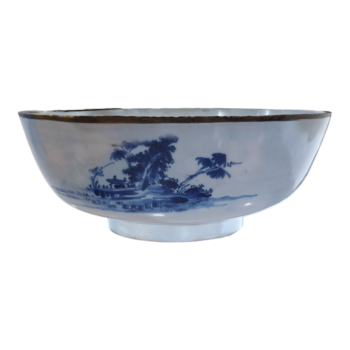
Porcelain bowl with copper edge inlaid with blue and white porcelain from the Qianlong period of the Qing Dynasty
Porcelain bowl with copper edge inlaid with blue and white porcelain from the Qianlong period of the Qing Dynasty

The blue and white porcelain bowls made during the Qianlong period of the Qing Dynasty are now preserved in the Hunt Museum in England. The outer edge of the bowl is decorated with a Pegasus frame,
Jingde Blue and White Porcelain Vase from the Kangxi period of the Qing Dynasty

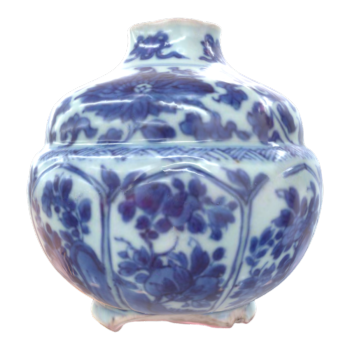
Jingde Blue and White Porcelain Vase from the Kangxi period of the Qing Dynasty

This Chinese cultural relic is a blue and white porcelain trumpet shaped vase fired in Jingdezhen during the Kangxi reign of the Qing Dynasty. The vase is decorated with fresh flowers and leaves, measuring 11cm in height, 11cm in width, and 11cm in length. It is currently housed in the Hunt Museum in the United Kingdom.
18th century Qing Dynasty copper doll "Qing Dynasty Mechanical Doll"
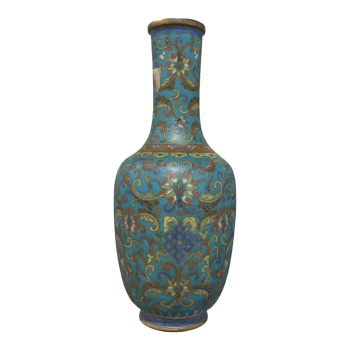
18th century Qing Dynasty copper doll "Qing Dynasty Mechanical Doll"

This cultural relic is an 18th century Chinese mechanical doll from the Qing Dynasty, depicting a man sitting on a lion. This man holds a spear and sits on a mythical lion (also known as the guardian lion of China). The exquisite craftsmanship of this doll is astonishing, and it is a testament to the professional skills and artistic talent of its creator or creator. The uniqueness of this doll lies in its spring driven mechanism, which allows you to appreciate the mobility of these small statues and marvel at the exquisite craftsmanship of past craftsmen even after being restored by the managers of the Krakow National Museum.
Porcelain from the Yongzheng period of the Qing Dynasty, titled 'Flat bottomed Oval Vase from the Yongzheng Period'

Porcelain from the Yongzheng period of the Qing Dynasty, titled 'Flat bottomed Oval Vase from the Yongzheng Period'

The vase is exquisitely painted, with a flat bottom, an oval shaped body, a cylindrical neck, and a flat, trumpet shaped mouth. The Qing Dynasty of China (1644-1912). Collected by the National Military Museum of Spain (Toledo, Spain).
Porcelain from the Kangxi period of the Qing Dynasty: "Porcelain Salt Bottles from the Kangxi Period of the Qing Dynasty"

Porcelain from the Kangxi period of the Qing Dynasty: "Porcelain Salt Bottles from the Kangxi Period of the Qing Dynasty"

This Chinese cultural relic is a porcelain called "Porcelain Salt Bottle from the Kangxi Period of the Qing Dynasty". It was fired during the Kangxi period of China (1662-1722) and is currently housed in the Krakow Salt Mine Museum in Poland. Before the development of porcelain production technology in Europe, porcelain from foreign countries had already been imported since the Middle Ages, and their prices often exceeded those of similar silverware. For many years, they have only been used for decoration, while their fashion trends continue to spread. These products have aroused the curiosity of European buyers due to their rich and exotic patterns.
Porcelain from the Kangxi period of the Qing Dynasty: Painted pottery bowls during the Kangxi period

Porcelain from the Kangxi period of the Qing Dynasty: Painted pottery bowls during the Kangxi period

Limestone relief Buddha statues from the Shunzhi period of the Qing Dynasty in the 17th century
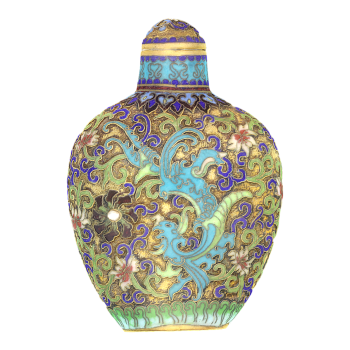
Limestone relief Buddha statues from the Shunzhi period of the Qing Dynasty in the 17th century

Enamel snuff bottles from the Yongzheng period of the Qing Dynasty in the 18th century

Enamel snuff bottles from the Yongzheng period of the Qing Dynasty in the 18th century

A snuff bottle is a container for holding snuff, which is delicate, compact, and easy to carry. During the Qing Dynasty, inhaling snuff became a popular trend among all social classes, and the pursuit of the material and craftsmanship of snuff bottles was even more extreme. The National Palace Museum in Taipei has a large collection of the most exquisitely crafted snuff bottles from the Qing Dynasty. This Yongzheng style enamel snuff bottle is made of milky white glass in the shape of bamboo nodes, with a color resembling spotted bamboo. There are brown spots on the green and yellow ground, and two small insects on the bamboo nodes. The bottom is painted with Lingzhi Kai Guang, and the red version of the regular script "Made in Yongzheng Year" is inside.
Painted ivory sculptures from the Qing Dynasty

Painted ivory sculptures from the Qing Dynasty

Folding Fan of Bull Bone Paper during the Qing Dynasty
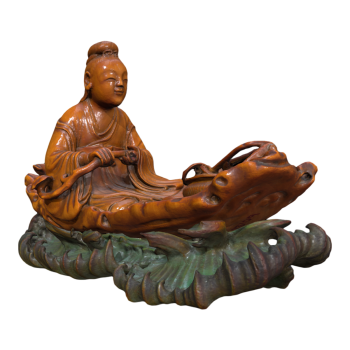
Folding Fan of Bull Bone Paper during the Qing Dynasty

Qing Dynasty boxwood carving "Dao Xian He Xian Gu"

Qing Dynasty boxwood carving "Dao Xian He Xian Gu"

This is a sculpture called 'Taoist Immortal He Xiangu', made in the 1700s during the Qing Dynasty of China (1644-1911). This sculpture is made of boxwood, with a base of colored ivory and an overall height of 13.5 centimeters. He Xiangu is one of the Eight Immortals of Taoism. It is said that she was a real person during the Tang Dynasty, originally named He Qiong. In this exquisite carving, He Xiangu sits calmly on a twisted and multi jointed raft surrounded by green ivory waves. In front of her was a bamboo basket filled with items related to Taoist immortality, while she held a branch of Ganoderma lucidum.
Bronze incense burners during the Qianlong period

Bronze incense burners during the Qianlong period

This incense burner was commissioned by Emperor Qianlong and bears the words' Made in the Qianlong Year of the Qing Dynasty ', possibly originating from a magnificent royal temple. Approximately 14 centimeters in height and 26.7 centimeters in diameter. This incense burner is a cultural relic from the Qianlong period of the Qing Dynasty (1736-95). Now it is collected in the British Museum.
Ink Cake "Panlong Ink Cake" during Jiaqing Period of Qing Dynasty

Ink Cake "Panlong Ink Cake" during Jiaqing Period of Qing Dynasty

This piece of ink cake is from China during the Jiaqing period (1795-1820) of the Qing Dynasty. The ink cake was green and shaped like a spiralling dragon. Ink cake (also called ink block) is dissolved in water and then ground into liquid ink on the surface of a square stone, which is used in painting and calligraphy. However, this precious piece of ink cake has never been used. the inscription on the side of the blue ink cake says that this set of ink cake was commissioned by governor chen huai of jiangxi province. This inset box is now in the collection of the Cleveland Museum of Art.
Qing Dynasty Ivory Sitting Pier "Small Ivory Characters Embroidered Pier"
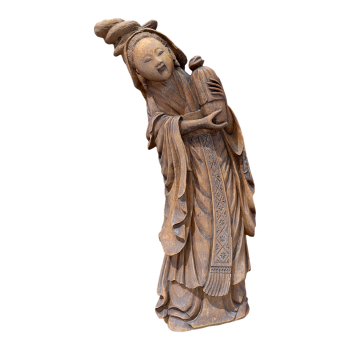
Qing Dynasty Ivory Sitting Pier "Small Ivory Characters Embroidered Pier"

The work is from the Qianlong period (1736-95) of the Qing Dynasty (1644-1911). At the age of the Qing dynasty, luxury goods became more popular and affordable, including merchants and literati in unofficial positions. The growing urban population has encouraged the consumption of luxury goods and local crafts. This piece of ivory carved and painted to imitate a small garden chair shows the exquisite skills of the talented craftsmen of the Qing Dynasty, the craft of embroidering figure patterns, which combines embroidery and furniture making, showing the unique charm of traditional Chinese handicrafts. This sill is currently in the collection of the Cleveland Museum of Art.
A wood carving of the Qing Dynasty

A wood carving of the Qing Dynasty

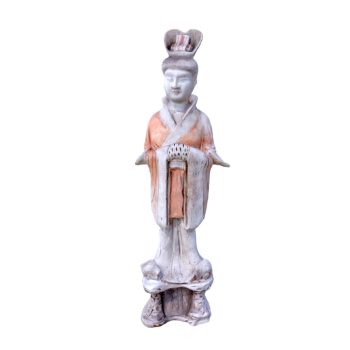
A wooden sculpture from the Qing Dynasty (1644-1912). She wore a long coat with lotus leaves on the back and framed her face with a high bow. Her earlobes look misshapen, with dangling earrings. The carvings are currently in the collection of the Spanish National Army Museum.